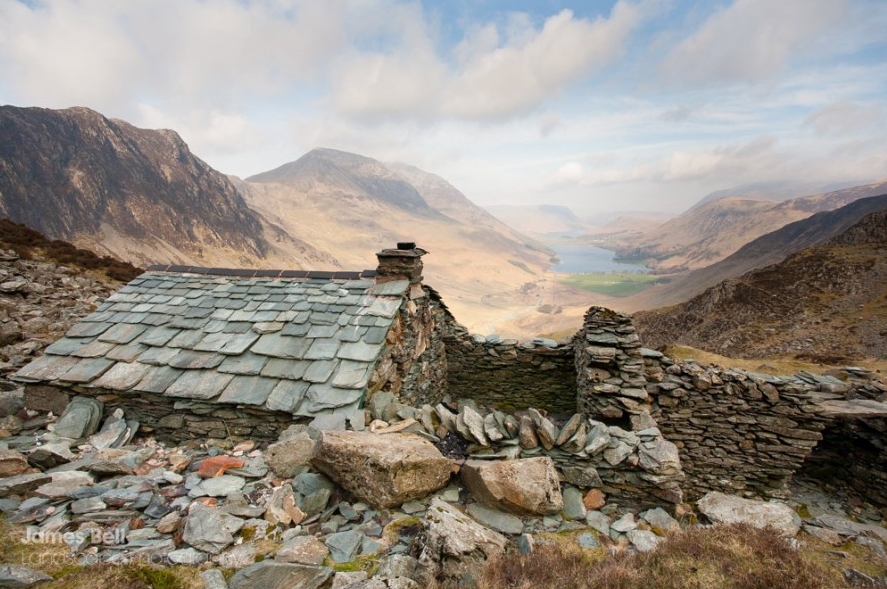
Up above Buttermere in the Lake District you’ll find Warnscale Head Bothy. Featured in many a photograph, this small stone hut is inspirational to all manner of photographers, both professional and amateur. And it’s easy to see why.
The bothy’s dramatic position looks down onto the lakes of Buttermere and Crummock Water, and is surrounded by the craggy slopes of Haystacks mountain. Slightly off the well-worn track that runs along the southwest side of Fleetwith Pike, you could quite easily mistake it for a ruin. But the far end is a watertight room with a secure roof, paned windows, and even a wood burner! While you’d still need plenty of layers and a good sleeping bag to stay there overnight, you at least won’t be exposed to the elements.
Known primarily for its incredible sunsets, the location is also fantastic when covered in snow in winter (though you need to be a capable winter hiker to tackle the conditions). There are excellent photo opportunities both from inside and above, with the rough stone building creating a wonderful contrast against the lush valley bottom. This really is a ‘room with a view’, and the small square window looks out onto one of the most impressive views in Lakeland.
History of Warnscale Head Bothy
If you know anything about the industrial heritage of the area, it will come to no surprise that the bothy is an old miner’s cottage. Built in the mid-18th century, it housed workers for the newly opened slate mine on Fleetwith Pike. You can learn more about the history of the mine – Honister Slate Mine, which is still active today – by visiting it. In fact, you could quite easily hike to it from Warnscale Head!
In 1812, the property was abandoned and left derelict for more than 150 years until it was finally restored – mostly by volunteers – and began to be officially used as a bothy. The building itself is privately owned but is maintained by the Mountain Bothies Association.

How to get to Warnscale Head Bothy
There is no vehicular access to the bothy, so if you want to visit, you’ll have to be prepared to hike with all your photography kit in tow. There are various approaches, so take your pick depending on interest and ability.
The most popular and from Gatesgarth Farm in the Buttermere Valley, and from Honister Slate Mine, which allows you to drive up much of the ascent and save your legs! However, if you’re after a longer hike, you can also get there from the neighbouring valley of Ennerdale, from the scree-covered slopes of Red Pike, or from the Derwent Fells.
If you’re planning to stay overnight, you should be willing to share and have a backup plan, as the bothy is popular, even with its tricky-to-find location.
From Buttermere

A handy pay-and-display car park is available opposite Gatesgarth Farm at the bottom of Honister Pass. There is reasonably limited space, so you’re best bet is to arrive early, or else later in the afternoon.
From here, cross the road and walk around the base of Fleetwith Pike until the path starts to climb. The path, though easy to follow, gets very steep in places and is loose rock, so be careful you don’t slip. Make sure you keep the river on your right.
When you reach a deep gully, it won’t be long until you can spot the bothy on the other side of the stream. Keep your eyes peeled, as the building blends well into the scenery. Continue past the location until the gully ends and you come across a ford in Warnscale Beck. Follow the path back down to the bothy.
From Honister Slate Mine

A slightly easier route – and one full of industrial heritage – begins from the Honister Pass National Trust car park (not to be confused with the Honister Slate Mine car park, which is for visitors only). You will, however, walk through the mine’s car park and follow the gravel road for a short while as it starts to ascend. Turn onto the footpath as soon as you can (indicated by the signpost for Great Gable and Haystacks) and continue along this very straight dismantled tramway. Look out for remains of historic industry here.
At the end of the straight path, you’ll reach a gravel road again and Dubs Hut, another bothy, but not the one you’re looking for! Instead, continue down the gravel road until you join a footpath on the left that takes you to a river crossing. Shortly after this, you’ll veer right, off the main path. Continue on until you meet a maze of tracks, after which you’ll have to hunt around a little bit to find the right place!